
Awareness is easy, understanding is harder.
Hayley Whitmarsh · 6 June 2026 · 4 min read
Knowing about someone’s experience isn’t the same as understanding it. Hayley Whitmarsh reflects on conversations that challenged her perspective and explores how ERGs can move beyond awareness to build human connection and deeper understanding.
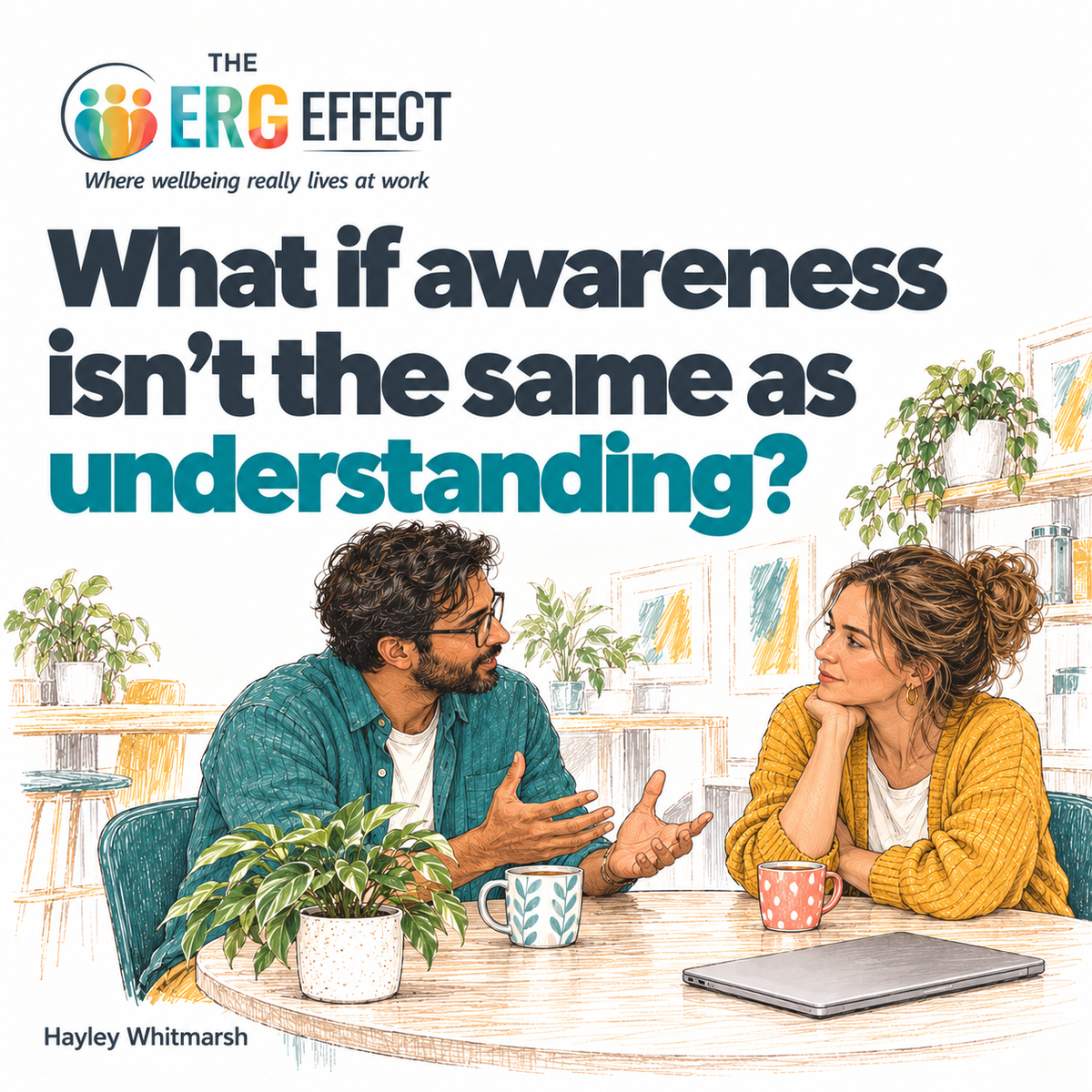
Awareness is easy - understanding is harder.
What if awareness isn't the same as understanding?
Over the last few weeks I've been having conversations with people as we shape our new In Conversation With series and, if I'm honest, I can't stop thinking about them.
On the surface they were speaker meetings. In reality they were conversations about life. I've spoken to people about domestic abuse, suicidal ideation, chronic pain, infertility, bereavement and identity. Their experiences were completely different and yet I found myself leaving each conversation thinking about exactly the same thing.
For somebody who spends a lot of time working in the wellbeing and inclusion space, I was surprised by how much these conversations challenged me.
Not because I learned something new, but because I understood something differently.
There is a difference.
Like many people involved in ERGs, wellbeing and inclusion, I have attended more awareness sessions than I could possibly count. I've listened to speakers, read articles, completed training and spent years supporting organisations that genuinely want to create more inclusive workplaces. I thought I was reasonably informed and, for the most part, I probably am.
What I hadn't really appreciated was how much of my understanding was still based on information rather than experience.
The more I listened, the more I found myself wondering whether awareness and understanding are actually the same thing.
I'm not convinced they are.
One of the people I spoke to lives with chronic pain. I've attended sessions about chronic pain before and I understand the basics. I understand that it can be exhausting, unpredictable and isolating. What I had never really stopped to consider was what it feels like to wake up every morning knowing that pain will be waiting for you before your feet touch the floor.
I spoke to somebody else about domestic abuse. Again, I understand the topic. Most of us do. We've read the statistics, attended the awareness sessions and know the signs to look out for. What I hadn't understood was the lasting impact it can have on how somebody sees themselves, makes decisions and trusts other people long after the abuse has ended.
The facts weren't new.
The understanding was.
That distinction has stayed with me because it has made me question something I suspect many of us working in ERGs and inclusion wrestle with, even if we don't always say it out loud.
How do we know if what we're doing is actually making a difference?
We spend a lot of time creating awareness. We organise events, invite speakers, share resources, run campaigns and promote awareness days. All of those things matter. Awareness is often where change begins.
At the same time, awareness is also the thing we measure because it is relatively easy to measure.
We can count registrations.
We can count attendees.
We can count views, clicks and downloads.
We can report on engagement figures.
What we can't easily measure is whether somebody's understanding has shifted.
We can't easily measure whether somebody leaves an event seeing a colleague, a friend or a family member differently than they did before.
That feels important because knowing what to say and understanding what somebody is experiencing are not necessarily the same thing.
Most people know they should support carers. Far fewer understand what it feels like to spend the night in A&E with a loved one before logging into work the next morning and trying to pretend everything is normal.
Most people know they should support mental health. Far fewer understand what it feels like to sit alongside somebody who is struggling and accept that you cannot fix it for them.
Most people know the language of inclusion. That doesn't automatically mean they understand what exclusion feels like.
The more I have reflected on these conversations, the more I have found myself wondering whether awareness has quietly become our comfort zone.
Not because awareness is unimportant, but because it is visible. It gives us something tangible to point to and report on. Understanding is much harder. It happens slowly, often invisibly and usually through human connection rather than information alone.
If awareness alone created inclusion, many organisations would be much further ahead than they are today.
That might be an uncomfortable thought, but I think it is worth sitting with.
The most powerful ERGs I come across don't just raise awareness. They create opportunities for people to hear experiences they would never otherwise encounter. They create space for conversations that move beyond statistics and into reality. They help people understand not just a topic, but a person.
Perhaps that is the real challenge for all of us.
Not simply asking what we want people to know, but asking what we want them to understand.
Because people rarely change their behaviour because they have been given more information. They change when something connects deeply enough that they begin to see the world through somebody else's eyes.
I'd love to know what you think.
Have you found ways of helping people move beyond awareness and into genuine understanding within your organisation? If so, I'd love to hear what has worked.
As always, I'd love to hear your thoughts.
Hayley