
Parents and carers: the ERG many people don’t think they need until life shifts
Hayley Whitmarsh · 6 February 2026 · 5 min read
Caring responsibilities don’t stop at the office door. Hayley Whitmarsh shares her own experience and explores how parents and carers ERGs help people feel heard, understood and supported when life changes.
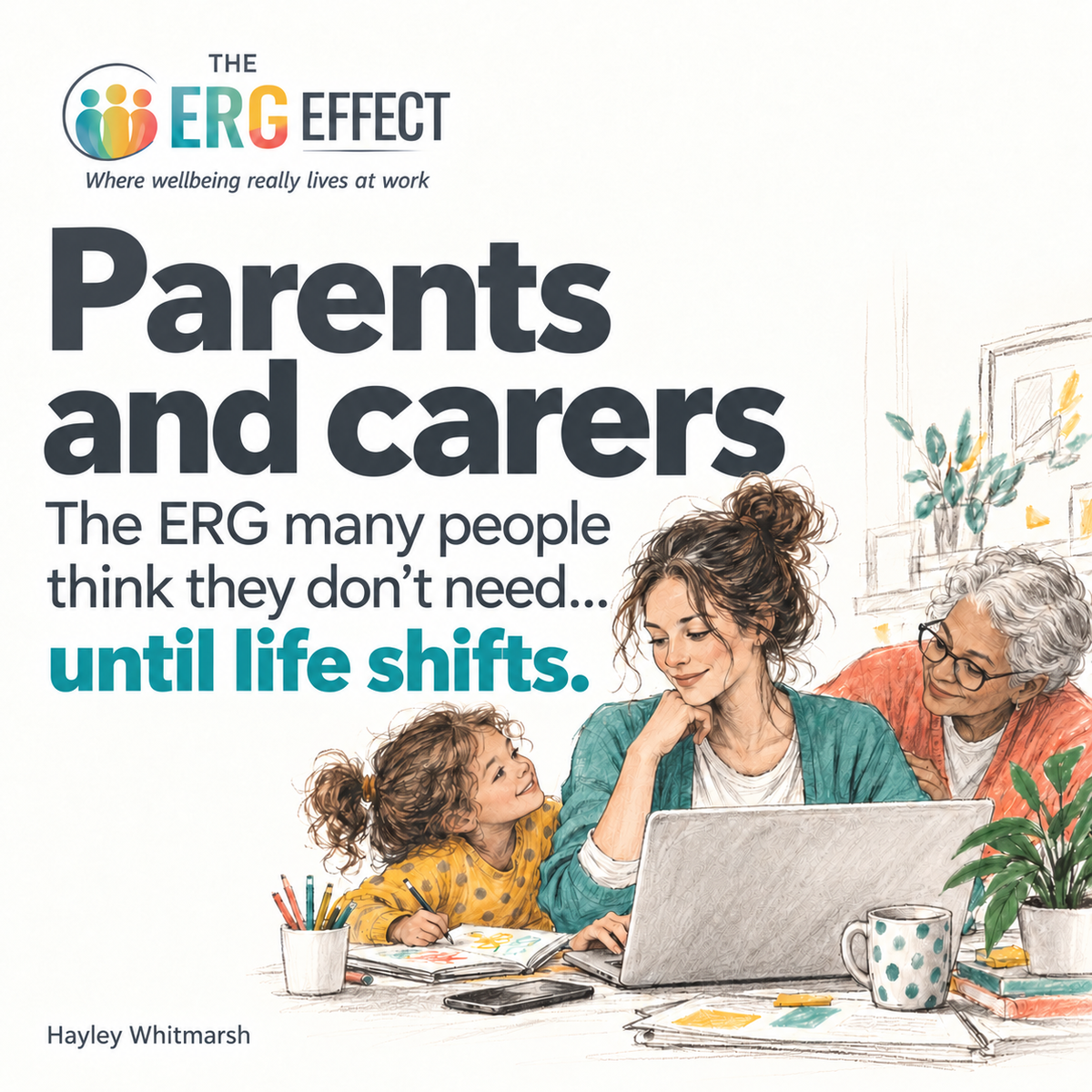
Parents and carers - the ERG many people don’t think they need until life shifts
People join parents and carers ERGs for different reasons.
Some join early, when life feels manageable, because they want connection, perspective, or a way to shape something better for others. Some join because they are thinking ahead. Others join because something in their life has shifted and they can no longer hold it quietly alongside work.
I know this because I have been there.
Years ago, I left a job I genuinely loved. Not because I stopped caring about my work, but because life at home became impossible to carry silently. My child was fourteen. I was going through a divorce. My child had just told me they were transgender. At that point, I did not need a solution or a policy. I was not looking for special treatment or a formal adjustment.
What I needed was to be heard and to feel understood.
Instead, I was made to feel that because my child was “older”, this should stay at the door. That my responsibilities at home were no longer relevant at work. That what I was carrying did not quite count. Looking back now, I can see it clearly. What I needed was not a flexible working form. What I needed was people.
People who understood that caring does not stop just because a child reaches a certain age or because the situation does not fit a neat category.
An ERG would have changed everything.
Why parents and carers ERGs matter more than we sometimes admit
Most people do not arrive at a parents or carers ERG because everything is going smoothly. They arrive because something has shifted.
It might be a new baby, a sick parent, school refusal, hospital letters, or a child in crisis. It might be caring for a sibling, supporting an adult child, or suddenly becoming responsible for grandchildren.
Often it is not one thing, but several, layered together. Life collides with work, and there is nowhere obvious to put the weight of it. People show up tired and conflicted. They worry about being seen as unreliable. They overcompensate to prove commitment, even when they are running on empty. Most of the time, they are not looking to be fixed. They already know their situation. What they need is to feel seen and understood.
Anyone who has facilitated one of these spaces will recognise the moment when someone finally says, out loud, “I am struggling.” Everything changes, not because there is suddenly an answer, but because there is understanding. Often, that alone is enough to make things feel more manageable.
The reality parents and carers are living with
The pressure on parents and carers has shifted in recent years.
Cost of living pressures, constant comparison through social media, higher performance expectations at work, and a growing amount of invisible emotional labour at home all add up.
The bar has moved but support has not always moved with it. This is not just about parents of young children. It includes parents of teenagers in crisis, people caring for elderly parents, those supporting adult children, foster carers, adoptive parents, siblings supporting siblings, and grandparents raising grandchildren.
It includes anyone quietly holding responsibility for someone else’s wellbeing alongside a full working life. This is the real parents and carers ERG landscape. It is broader and more complex than many organisations are designed for.
When policy is not the problem, but conversations are
Many organisations genuinely want to be fair and believe that fairness comes from treating everyone the same. Standard approaches and blanket policies can feel safe and consistent. But sameness is not the same as fairness, and it often misses the reality of people’s lives.
Flexibility is not unfair. It is often misunderstood. For one person, an earlier start and finish might make life workable. For another, a later start could ease pressure. Sometimes a temporary adjustment would prevent someone from breaking altogether. People rarely leave because of a policy document. They leave because of how a conversation made them feel. Unseen. Dismissed. Like their reality was inconvenient or too much.
This is where ERGs quietly change things.
Not by replacing good management, but by creating space for honesty and understanding long before issues become visible elsewhere.
What parents and carers ERGs notice first
ERG leads often notice when something is starting to fracture long before it shows up in data or engagement scores. They hear it in quiet messages, in people staying behind after sessions, and in the pauses before someone finally shares what is really going on.
Across the parents and carers ERGs we work with, the same patterns appear again and again. Confidence starts to slip. People apologise for needing flexibility and stay late to prove commitment, even when they are already stretched. Burnout builds slowly, showing up as tiredness that never quite lifts, foggy thinking, or a sense that everything feels heavier than it used to. Over time, some people begin to withdraw. They miss sessions, stop speaking up, or disengage quietly. Not because they do not care, but because showing up feels like too much.
Organisations may see attendance dropping. ERG leads see people struggling.
A practical reality check for parents and carers ERGs
If you lead or support a parents and carers ERG, you will recognise this feeling. You often know something is not quite right, but it can be hard to turn what you are hearing into clear, meaningful action. That is why I have created a simple, practical tool to support this work.
TheParents and Carers ERG Reality Checkis designed to help you understand the invisible load your people are carrying, spot gaps between policy and lived experience, and turn insight into realistic, visible action. For this edition, the tool is available as a downloadable PDF. While the webpage is being finalised, I will share it directly. If you would like a copy, you can reply to this newsletter or message me on LinkedIn and I will send it over personally.
If this edition has surfaced something familiar or uncomfortable, I am always open to a quiet, no pressure conversation.
Sometimes being heard is where everything starts.
Hayley